Click Here to Go to Home Page to Register for a Presentation
Discussion Outline
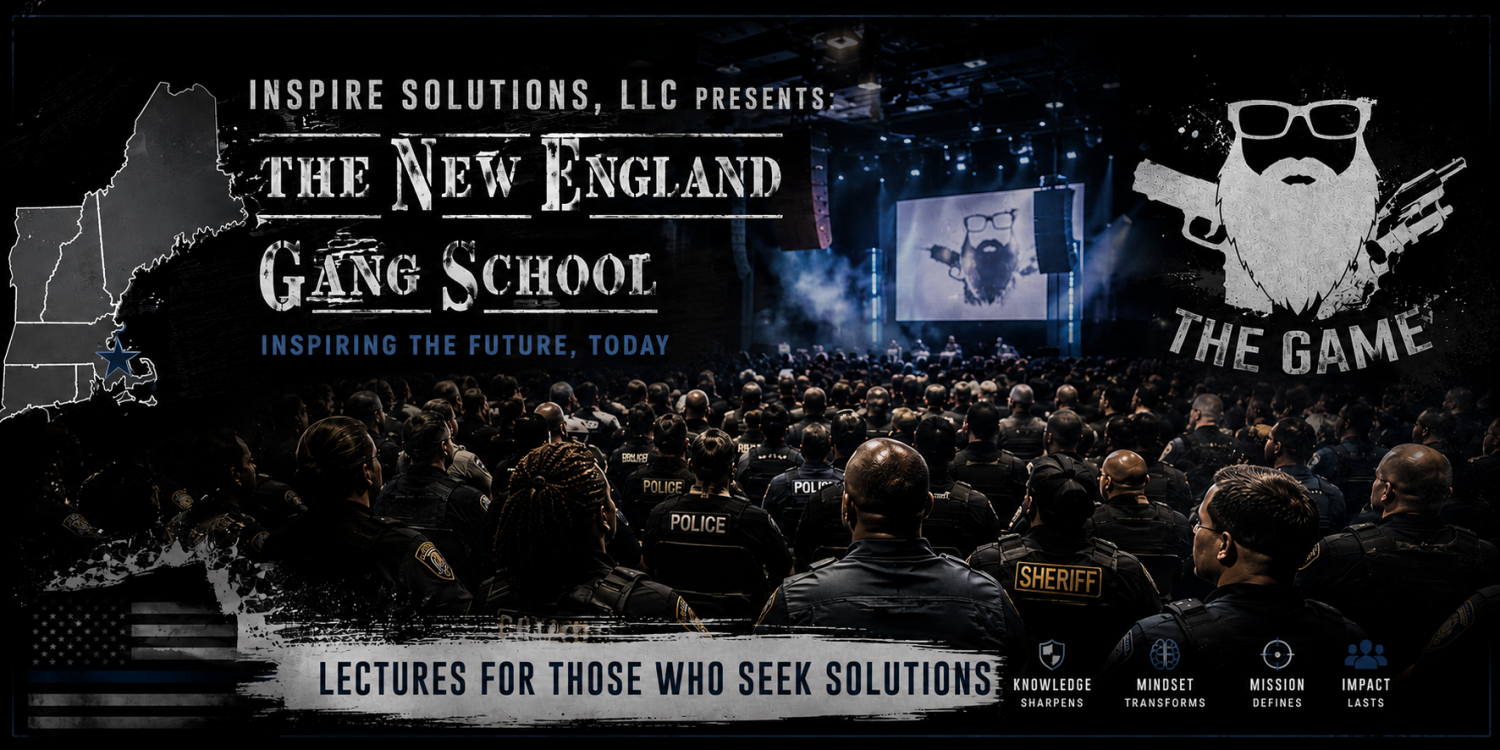
This presentation began as a gang investigator presentation in New England. Its popularity grew for its ability to transcend jurisdictional variances by focusing on the gang trends that are locally universal. Its high speed and energetic delivery method eradicates the fear of the boring “cop class.” This presentation is intended to give police officers an understanding of street level gang activity through a realistic lens of the empathy that it deserves. This lecture was created as a specific expansion of concepts that relate directly to street level gang investigations. The presentation is a tool to understand gang culture in a manner that allows us to be more productive and successful with our street contacts.
As stated in the Disclosure, it is important for law enforcement to understand the gang mentality as it exists here, in New England, in order to successfully document the many nuances in gang related behavior. And it is equally important for law enforcement to recognize the factors that attracted that youth who gets pulled into this world, in order to have better interactions with them, avoid unnecessary citizen’s complaints, and to be able to reach the ultimate goal of safety for the police, the youth, the citizens, and the community. Similar to the heroin epidemic which plagues all of our communities in New England, the gang life is a systematic recruitment of the youth; and it can be, in many cases, far more physically and mentally appealing or incarcerating for them, than any fear of jail.
This presentation will open your eyes to the fact that the very targets of your investigations are often victims of their own indoctrination.
These Childish Games – An Introduction to Gang Behavior:
In this introductory portion of the presentation, we will discuss how gang behavior is surprisingly similar to the behavior of simply… any youth. From the “secret handshakes” to the “stop snitching” mantra, the youth are easily manipulated into following trends, and bending to the will of the more influential older generations. This is referred to as the “indoctrination” of the youth.
The Hunger Games – Understanding Poverty, and the Toll That It Can Take:
This portion discusses how a climate of poverty can often be a breeding ground for gang culture. We will discuss the role of the family and the community, as well as the role of the police; and how an understanding of the limitation of choices offered, can help us understand the decisions made by the small number who inevitably join the gang lifestyle.
The Rap Game – The Role of Music in Pop Culture and Beyond:
This block focuses on social influences; such as music. We will explore how these influences serve as a mirror-ball for the real life issues in the streets. The internet is the playing field of gang culture… online. In the eyes of the youth, the opportunities of music and social status within the gang world will offer “a way out”, while simultaneously, and quite ironically, solidifying their place in an ongoing street fight that brings violence and trouble to all.
The Game of Life – Seeing the Potential, and the Lack of Opportunities:
This block discusses the options available to the youth who grow up in this game. Petty crimes become small fines, which later become financial burdens; thus creating a pseudo self-fulfilling prophecy of struggle. Law enforcement has the ability to introduce this cycle upon the youth, and therefore the opportunity to break this cycle for the youth. For the youth, the ever-revolving cycle of expected loyalty to the street life, and the need to survive, will often crash head-first into any efforts to “go straight” or to “live a normal life”. We will discuss the word “normal” and see how this is in fact a moving target depending on one’s own perception. What are the consequences of “indoctrination?” And what are the options that are left?
Homegame Uniforms – What to Wear… and Why?:
All aspects of life require that we fall in line to the demands of social pressures and current trends. We will discuss clothing styles, branding, and marketing. Some trends are more dangerous than others. Some can get you praise, while others can get you killed. And the difference may be only a matter of a few city blocks.
The Best Selling Game of All Time – The Unapologetic Bloody Hands of Pop Culture:
Pop culture is great when it leads to a few catchy songs and a few forgettable clothing fads. But at what point is pop culture simply gaining profits from the death of the youth in the inner cities? Who are the heroes in pop culture and who are the heroes in the streets? And why? Who do we place upon pedestals for praise? What sort of behaviors or actions (or crimes) are considered “putting in good work” by the youth that are seeking this acceptance or praise? As for Macro-Marketing: What sort of material goods are promoting violence; without the knowledge of a vast majority of society?… Or maybe even with it?
Game Recognizes Game – What are Gang Signs; and What are NOT:
Not everything that appears to be gang related, is gang related. We will discuss many of the common misconceptions of gangs, and their “branding”. What aspects of gang culture are universal, and which ones are specific to geographical areas. And how can we be careful not to confuse them all?
The Game Needs Players – A Pattern of Child Recruitment:
Gangs are in a constant recruiting process. As discussed earlier, the mainstream media and pop culture will perform most of the top marketing. How is it that the gangs can (literally) advertise that you can die for participating, yet they consistently have no issues recruiting new “soldiers?” The mindset of a person who volunteers for such a position or role, is not as systematically rare as you may have thought. In fact, …the answer may sound very familiar.
Video Games – The Role of the Music Video:
As it was discussed earlier, the music world is a meeting place for friends as well as enemies. Music videos are the new street media. Gangs utilize this medium to self-promote as well as to perpetuate online feuds. These artistic fantasies are then translated into real life feuds that can often lead to real-life violence. We will discuss how to recognize these platforms, and to translate the art.
Online Games – Feuds Fought in a Virtual Setting:
With the advent of social media, a post on one’s Social Media “wall” is as significant as (what used to be) graffiti on the “wall” of a rival territory. The game has changed. The online feuds of today, are the real life crimes of tomorrow. How do we stay relevant, and on top of OUR game, in order to be in the best position to recognize the gang’s mission.
Mind Games – P.T.S.D., Trauma, and Mental Health, in the Gang Space:
Gangs are often described as heartless, merciless, and capable of acts that boggle the mind. However, similar to soldiers in combat, a lot of these behaviors are also learned, indoctrinated, and ingrained into their individual psyches by a series of collective experiences and traumas. Over time, like soldiers, there is a “normalization” of the violence, and even a propensity towards it; as it is seen as the primary solution to problem solving. Sprinkle in the peer pressure of ego, and image, and it is a breeding ground for mental health disorders like PTSD. When combined with potential innate mental health issues, poverty, limited options, and physical (or other) abuse,… some gang members can be psychologically damaged beyond the normal means of understanding by those who were born more privileged. How do we recognize these signs, and what does it mean for us? How can we, as the police, be a source of help, rather than further harm?
A Game of Chance – Policing Through Empathy vs Policing Through Luck:
What kinds of ideas are available for law enforcement to most effectively combat gang violence? What kinds of cases can be made? And what is the skill level required? What are the consequences of just doing things the way that they had always been done?
The Game Will Be Televised – A Discussion of the Gang Feud in Real Time:
Where are the trends heading? And what can we expect next? And can we make a positive impact on our community and identify the criminal element; while upholding our pledge to respect all citizens. We will discuss scenarios of where we are today, and what may come next.
It should be noted that no specific case can ever be predicted, and so no lecture or story can ever replace your need for legal justifications or help to elevate your own observations. Neither this presentation nor any like it, can provide any “certification” to increase your reasonable suspicion or probable cause. As in all cases, that must come from you, and your ability to articulate your decision making process. The topics discussed can vary from venue to venue; based on the location, and the needs requested.